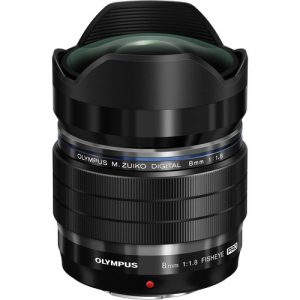
1. Olympus M.Zuiko Digital ED 7-14mm F2.8 Pro Lens

The M.Zuiko Digital ED 7-14mm f/2.8 PRO from Olympus is a 14-28mm equivalent lens featuring a constant f/2.8 maximum aperture for consistent performance throughout the zoom range. A weather-resistant design benefits handling in trying conditions while an L-Fn button offers lens-based control over various settings. Additionally, a Movie & Still Compatible autofocus system achieves fast, smooth, and silent focusing performance to benefit both photo and video applications. As a fast, high-performance wide-angle zoom, this Micro Four Thirds lens pairs an optimized optical layout with refined physical details to excel in a variety of working conditions. The lens construction incorporates two aspherical ED (extra-low dispersion) elements, one DSA (Dual Super Aspherical) element, one aspherical element, three Super ED elements, one ED element, and two HR (high-refractive index) elements into its design to minimize aberrations, distortion, and color fringing while also contributing to overall image sharpness, clarity, and color fidelity. Movie & Still Compatible (MSC) autofocus system benefits both photo and video applications due to its smooth, quiet, and fast performance.
2. Olympus M.ZUIKO DIGITAL ED 17mm F/1.2 Black

OMEGA M.ZUIKO DIGITAL ED 17MM F/1.2 BLACK – Features & What You Need to Know
The Olympus M.ZUIKO DIGITAL ED 17mm F/1.2 Black is one of the best cameras you can buy if you are a hardcore photographer who wants to shoot amazing images with the greatest optical zoom lens available. Many professional photographers will swear by the Olympus M.ZUIKO DIGITAL ED 17mm F/1.2.
When you get a new camera, you want to look at all the features and see what is included. The M.ZUIKO DIGITAL ED 17mm F/1.2 Black is no exception. In this review, we will take a closer look at what the Olympus M.ZUIKO DIGITAL ED 17mm F/1.2 Black has to offer.
What is included in the Olympus M.ZUIKO DIGITAL ED 17mm F/1.2 Black? The lenses are what will most likely sell the camera.
We should look at the F/1.2 zoom to start. This lens offers the best overall zoom available with the widest aperture available.
This lens has three different multi-coated lens elements, a high-performance dust and moisture resistant coating and an anti-reflective coating that go beyond the ordinary. If you use any photography mediums that involve long exposures, you need this lens.
You also get a three-inch, super-fast autofocus system. You will be able to keep that focus sharp throughout your image.
There is also a new large 7-axis image stabilization. This lens will shake less and still deliver great image quality.
In terms of what comes in the camera bags, there is a nice leather carry case, so you don’t have to worry about carrying around heavy bags. The camera bags are a little big, so take some time to make sure you get the right bag.
The same lens will be featured in the Olympus M.ZUIKO DIGITAL ED 17mm F/1.2 Black, except for a few different special versions. The basic 16-megapixel design will be found on all the versions.
It will also have a brighter electronic viewfinder. This is more for fashion photographers who want to capture a better image.
With the Olympus M.ZUIKO DIGITAL ED 17mm F/1.2 Black, you will get the famous Hyper Sonic Motor, which produces incredible optical performance. When you take pictures, this lens produces sharp, clear images in a fraction of a second.
3. Olympus M.ZUIKO DIGITAL ED 75mm F1.8 Silver

The Olympus M.ZUIKO DIGITAL ED 75mm F1.8 Silver Detail Review has been produced by the company. It is one of their more powerful fast lenses. It allows the user to have the ability to remove the filter from the lens.
The Zeiss company, commonly known as Zuiko Digital Ed has been in business for more than sixty years. The company has its manufacturing facility located in Japan. As a result, many are now enjoying the company’s lens and camera products. These lenses are some of the best known in the industry.
The Zeiss Company has produced a series of lenses that are highly popular in the field of photography. Many are hoping to find some of these lenses in the company’s line of cameras. Some of the lenses are particularly renowned, such as the Zuiko Digital ED. They are well known in the industry.
Many are wondering how this new lens compares to the other Zeiss lenses. This review will help them get an idea of what they have to look forward to. This lens is one of the top rated lenses on the market today. It is rated five out of five stars in the Amazon consumer reviews. This means that there is great recognition for this lens.
This lens has an excellent image quality. It is capable of producing excellent sharp images. It has an auto focus system. However, it is advisable to have the focusing using the camera with manual focus.
There are numerous disadvantages that must be considered before purchasing this lens. However, it is imperative that they are taken into consideration before making a purchase. This will help the user understand what they are doing before making a decision.
The Zeiss company has recently introduced a new digital camera called the Zeiss ZM. It is equipped with the same Zeiss ZM lenses that are featured in the Zeiss ZM.2. This allows for comparison with the Zuiko Digital ED 75mm F1.8 and the other Zuiko Digital ED lenses.
Some may wonder why this lens is not included in the lineup. The Zuiko Digital ED 75mm F1.8 has been designed to use the camera that has the same number of optical elements as the other Zuiko Digital ED. The other Zeiss model has five as opposed to the seven optical elements of the Zeiss.
The Zeiss ZM.2 has been manufactured to provide the features of the Zeiss ZM. It has been manufactured to take advantage of the features that are more compatible with the Zuiko Digital ED. The Zeiss lens is not as strong as the other lenses that are offered in the line.
A fact that is less well known, is that the Zeiss ZM.2 has seven elements instead of five. It also comes with a fisheye lens like the Zeiss ZM. It allows for clearer field of view when the user does an FOV measurement.
The other side of the coin is that the Zeiss lens is much lighter than the Zeiss ZM. Although the Zeiss lens will cost the user more than the Zuiko Digital ED, it can prove to be the most popular lens. The price will vary depending on the type of lens that is purchased.
If the user has never owned a Zeiss lens, they should be aware of the advantages that the Zeiss brings. These lenses have been seen in many films and the features of these lenses have been proven time again.
4. Olympus M.ZUIKO DIGITAL ED 17mm F1.8 (Silver)

A flexible lens for general shooting, the silver M.Zuiko Digital 17mm f/1.8 from Olympus is a 34mm equivalent wide-angle prime for Micro Four Thirds mirrorless cameras. The wide field of view pairs with the bright f/1.8 maximum aperture to benefit working in difficult lighting conditions, and it also offers increased control over depth of field for working with selective focusing techniques.
5. Olympus M.ZUIKO DIGITAL ED 12mm F2.0 SILVER

A compact wide-angle prime with intuitive handling and advanced optical design, the silver M.Zuiko Digital ED 12mm f/2 from Olympus is a 24mm equivalent lens for Micro Four Thirds mirrorless cameras. The lens’s optical design makes use of one aspherical element, one DSA (Double Super Aspherical) element, and a Super HR (high refractive index) element to reduce spherical aberrations and control distortion for notable sharpness, and one extra-low dispersion element reduces color fringing for high clarity and color accuracy. One extra-low dispersion element minimizes chromatic aberration and color fringing for greater clarity and color fidelity. Manual focus clutch lets you quickly pull the focusing ring into place for direct, intuitive focus control. This also reveals the Snapshot Focus mode, which incorporates a depth of field scale for working with hyperfocal focusing and zone focusing techniques.
all rights reserve to s world electronics.
 Photographyblogs